AI talent strategy — specialist pipeline and AI Quotient expanding across the organisation

AI Capability Is Becoming an Organisational Property, Not a Team.

Develop AI Talent

Two talent streams now run inside any organisation building seriously with AI: a specialist team that designs and runs the systems, and the wider workforce upskilled to amplify daily output with AI.

The engagement partners with your HR function, applying AI-domain experience to build the specialist team and deliver the upskilling that raises the organisation's ambient AI Quotient.

Unique Requirements for the Deep and Wide Talent Streams

The Two Talent Streams

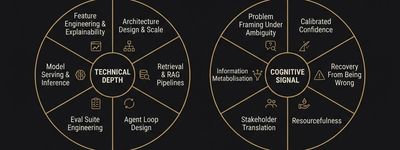
Installing the AI Specialists talent stream is not business as usual for HR. This is a young discipline whose successful attributes are still evolving, and the labour market rarely offers full capabilities ready-made, so achieving full competency requires accelerated development of these specialists. The right hire is identified by slope. Knowing what that slope looks like, and how to develop it rapidly, is the crux. The second stream, uplifting the ambient AI quotient, addresses a different challenge: most AI upskilling programmes stop at technical knowledge and miss the cognitive and learning changes that determine whether practitioners use AI well. That gap widens when programmes ignore andragogy.

Building the team that runs AI

AI Specialist Pipeline

The talent lifecycle, calibrated for a discipline that's nascent for standard HR

The AI Specialist talent stream places demands on the talent lifecycle that standard HR practice is not calibrated for. Specification requires translating a live AI use-case backlog into roles and skills, a judgement that cannot be made from market benchmarks alone. Recruitment requires a working definition of what good looks like in a discipline too young for credentials to signal it: the slope of learning, the reasoning patterns under uncertainty, where the function sits in the organisation. Development requires closing the gap between tooling fluency and production judgement, a different problem from most technical upskilling. Knowledge transfer requires AI systems to be legible to the team inheriting them rather than treated as black boxes. Retention requires a career architecture built for roles that did not exist five years ago.
Uplifting the ambient AI Quotient

AI Quotient

AI levels and raises the expertise curve. The organisations that understand this uplift everyone

AI gains now sit inside the moment of work far from the AI team: the marketer executing algorithmic campaigns, the lawyer reading contracts across multiple languages, each assisted by AI. AI Quotient is the third talent lens after IQ and EQ, the ability to harness AI for multi-fold capability enhancements. Developing it is where most programmes face the challenge. The first reason is that AI Quotient is more than a single skill. Harnessing AI's full potential takes technical craft, cognitive frameworks, and learning agility developed together, worked as a capability map against the function's real tasks rather than a single literacy course. The second is that capability has to change behaviour, not merely raise awareness, and adults learn differently, which is why the modules are taught through andragogy, designed to engage adult learners so the skill lands in daily work. The third is that individual facility is not enough on its own: without awareness of risks, responsible-use guardrails and a path to scale, the capability never becomes something the organisation owns and can trust at volume.

BUILDING THE TEAM THAT RUNS AI

The AI Specialist Pipeline

Talent Stream 01

Specifying the team, hiring against AI signal, transferring the system, retaining post-LLM talent.

Five Reads Where AI-Domain Judgement Reshapes the Talent Lifecycle.

T01 · AI Practitioner's Lens

Standard HR practice is calibrated for disciplines where role taxonomies, hiring signal, and retention playbooks have settled. Applied AI is none of those. The five perspectives below are where an AI practitioner's read changes the call inside each lifecycle stage — what the right team shape is, who can ship under production conditions, how capability transfers without decaying, and what keeps senior talent in the building. The focus is applied AI: implementation, deployment, production operation. Foundation model R&D is out of scope.

Role Architecture for Implementation Work

Which applied-AI roles the live use-case backlog actually demands: AI Engineer for agentic and retrieval systems, ML Engineer for fine-tuning and serving, Eval Engineer for production quality, AI Product Lead for system design. Generic 'data scientist' headcount is not the answer; the right shape of team depends on what the backlog requires.

AI Signal in Hiring, Beyond Engineering

What separates a candidate who can pattern-match on AI vocabulary from one who builds AI capability in your context. Beyond shipping a working system under production conditions: inventing new AI-native processes the function did not have before, translating fuzzy business requirements into precise AI specifications, and the transitional problem-solving that opens productivity routes the team has not seen yet. Calibrated confidence, problem framing under uncertainty, and recovery when the system misbehaves are the signals that do not show up on a CV and cannot be tested with a generic coding screen.

Development Belongs on the Job

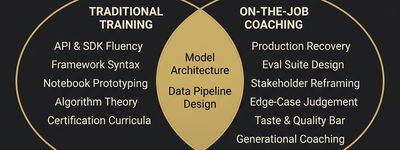
Most AI talent development is still routed through external courses and certifications, the format the industry inherited from generic technical training. The format that actually transfers capability is on-the-job: a senior practitioner embedded in a live project, modelling taste and recovery in real time, choosing where to intervene and when to let the team struggle. That judgement is what separates a coached project that produces lasting capability from one that produces a delivered artefact and a certificate.

The Hand-Over Has to Be Transparent

Outsourced AI delivery often produces a working system the inheriting team cannot evolve: a black box dressed up with documentation. Capability transfers when know-how moves openly during the project rather than at sign-off: design decisions traced as they are made, eval suites and monitoring playbooks co-authored, on-call runbooks built by the team that will run them. The internal team owns the system because they helped build it, not because they were trained on it afterwards.

Retention Conditions for Applied AI

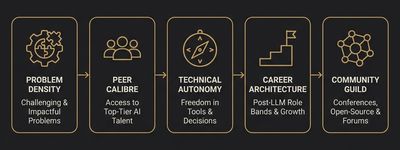
What actually keeps senior applied-AI talent in a building: problem density, peer calibre, technical autonomy, decision rights, and a legible career path for post-LLM roles. The conditions are non-generic, and the diagnostic is judgemental rather than survey-based.

AI-Specific Requirements Across Talent Development Stages

T01 · The AI Specialist Pipeline

Five development stages building toward one outcome: an applied-AI function the organisation owns and can sustain without permanent outside support. The arc runs end-to-end when a team is being built from scratch. Built on top of the HR architecture and operating frameworks, we support AI-domain needs at each stage — what the team should actually look like, who can ship under production conditions, how capability transfers without decaying, and what keeps senior talent in the building.

UPLIFTING AMBIENT AI

Enterprise AI Quotient

Talent Stream 02

Raising the third quotient, after IQ and EQ, across every function already operating in AI-augmented workflows.

Where AI Raises the Whole Expertise Curve.

T02 · From IQ to EQ to AI Quotient

AI now sits inside the moment of work in functions that have nothing to do with the AI team: the analyst drafting a brief, the operator triaging a queue, the lawyer reading a contract, the product manager scoping a feature. The capability that decides whether that moment lands well is not the model; it is the practitioner's facility for working with it. After IQ measured raw cognition and EQ added emotional facility, AI Quotient is the third lens, the practitioner's capability to leverage AI as an extension of judgement at the moment of work. It is no longer optional in functions already operating in AI-augmented workflows.

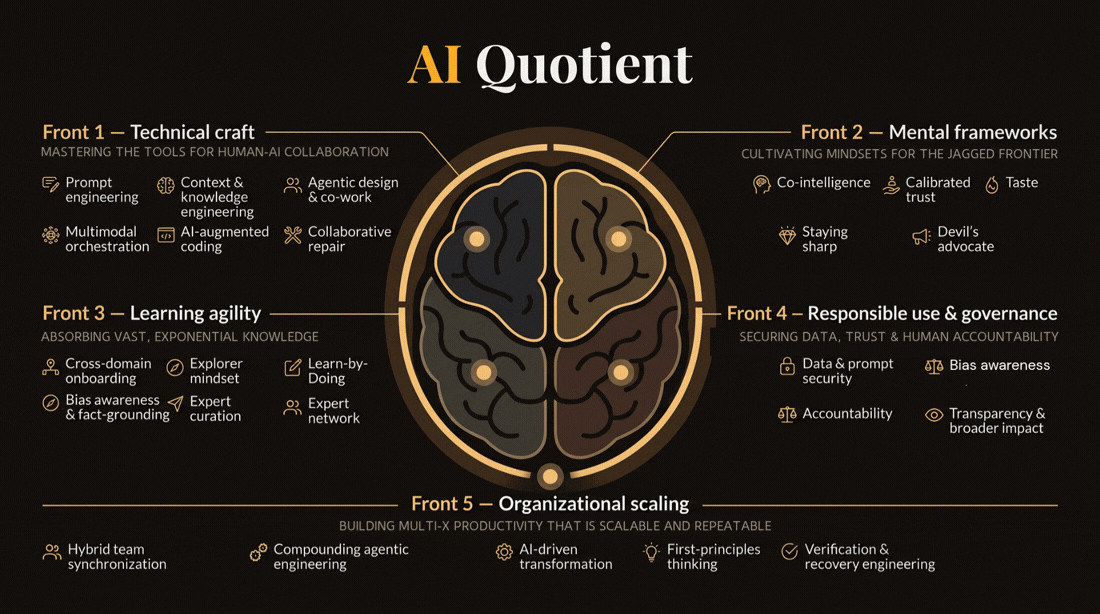
AI Quotient is workforce-wide rather than specialist. The lift is largest where domain depth already exists, and the failure mode is consistent: organisations that route AI Quotient through a generic "AI literacy" rollout produce awareness without behaviour change. What develops AI Quotient instead is a structured capability map taken in modular blocks against the function's actual work: five fronts that build on each other, each carrying a defined hard skill and the judgement habits that keep the skill productive.

AI Quotient framework diagram — five fronts shown around a central brain illustration. Front 1 Technical Craft, Front 2 Mental Frameworks, Front 3 Learning Agility, Front 4 Responsible Use and Governance, Front 5 Organisational Scaling — each labelled with its sub-capabilities.

The five fronts below are the AI Quotient capability map; the pillars further down are the modular delivery sequence through which the map is built.

AI Quotient Has Five Distinct Fronts.

T02 · The Five Fronts

Five fronts make up the AI Quotient capability map. Fronts one through four are the individual practitioner's terrain: craft, framework, agility, governance. The fifth is the wrapping layer that turns individual capability into capability the organisation owns.

Capability Lands Only When the Pedagogy Is Right.

T02 · Pedagogy

Most AI upskilling stops at technical knowledge, well short of behaviour change. What separates a programme that produces certificates from one that produces capability is the pedagogy. Three principles do most of the work, each grounded in how adults actually acquire and apply a new craft. They are not options; they reinforce one another.

Andragogy & VARK

Adults do not learn the way children learn. They need relevance to the work in front of them, autonomy over how they engage, and the chance to draw on prior experience as scaffolding. The format is structured around those levers, and the VARK lens (visual, auditory, reading-writing, kinaesthetic) ensures the material reaches every learner mode rather than defaulting to the format the designer is most comfortable in.

Grokking & First Principles

Skill that lasts is built on reasoning from fundamentals, not pattern-matching on prompts that worked last week. Grokking, the moment surface fluency collapses into deep understanding, is what lets the practitioner adapt as the frontier moves. The curriculum is designed to force that collapse rather than reward memorisation.

Applied & Hands-On

The work happens on the practitioner's own backlog, not on synthetic exercises engineered for a slide deck. Capability that does not get used in week one does not get used in week eight. Every module is structured around an artefact the cohort ships, reviewed against the standard their own function will hold them to.

The Integrating Mechanism · The Classroom Is the Project

The three principles only land when they're taught inside delivery, not alongside it. The integrating mechanism is the embedded coach, a senior practitioner who joins a project the cohort is committed to ship, modelling judgement and taste in the work itself. The pedagogy does its real work in the moments that decide whether the capability sticks: when a prompt has to be revised, when the eval suite throws a false signal, when the stakeholder review needs reframing. By the second or third generation through the model, the cohort being coached has become the cohort that coaches the next, and the pedagogy is no longer something the organisation buys; it is something the organisation owns.

What the Next-Generation Workforce Becomes.

T02 · Outcomes

The shift is not incremental. The workforce calibrated to AI augmentation operates against a different ceiling: orders-of-magnitude output, deep range across multiple disciplines, decisions held against more frames at once, automation that reaches into judgement work, and a function that operates at the algorithmic competitive bar rather than a generation behind it. Five observable outcomes, visible in the work rather than on certificates.

Hyper-Productivity at 10× and Beyond

The capability shift is order-of-magnitude, not a matter of 20% gains. Practitioners who have learned co-work fluency produce in hours what a junior team previously delivered in a week. Synthesis-heavy work such as briefs, analyses, decks, code, and contracts collapses against a different cycle time. The pattern repeats across functions wherever the reflexes are built: the ceiling is not 20% higher, it is reset categorically.

M-Shaped Talent as the New Default

The T-shape, one deep specialism flanked by general breadth, was the template for a generation. AI collapses the cost of going deep in adjacent fields, and the M-shape becomes attainable: practitioners with multiple deep stems. The algorithmic marketer who codes the attribution model, runs the experiment, and ships the campaign. The product manager who writes the eval suite, prototypes the agent, and runs the user study. The lawyer who builds the contract-extraction agent and writes the brief. Roles consolidate, hand-offs collapse, and the cost of standing up a new product line drops because fewer people hold more of it.

Elevated Human Cognition

Decision quality is the through-line. AI reaches into humanly impossible data and context volumes: millions of signals, the connections between them, decision points at a density beyond human bandwidth. The human supplies what AI is blind to: accountability, judgement, and guardrails for the high-stakes call, the systems sight to read how an automated change cascades into customer experience, compliance, or supply, and the change-capability that holds a continuously re-tooled workforce together through rolling disruption. Symbiotically paired, the next-generation practitioner is not a faster operator but a more elevated decision-maker, with every call landing at a quality neither side could reach alone.

Agentic Automation Across Non-Deterministic Work

Classical automation handled deterministic flows: if A then B. The new frontier is automation across judgement work: claims that need adjudication, contracts with ambiguous clauses, escalations whose right answer depends on context. The practitioner designs and verifies agents that resolve the routine majority of these cases end-to-end, escalating only the genuinely ambiguous to a human. The function's reach extends into work that previously required a person at every node.

Built for Algorithmic Hyper-Competition

The competitive bar in every market is being reset by agentic systems: pricing that adjusts by the minute, marketing that personalises to each customer in real time, operations that re-route around disruption without a human in the loop, commerce that pre-empts the order before the customer thinks of placing it. Workforces calibrated to this bar set the terms in their category. Those that are not compete against a different class of opponent and lose share quietly. The next-generation practitioner builds, deploys, and operates at the same cycle time the market itself now runs at, across supply, operations, commerce, marketing, and brand.

Patterns That Recur Across Both Tracks.

Field Notes

Observations from talent engagements across both mandates, specialist pipelines and modular workforce programmes. The patterns below are not recommendations; they are what the evidence consistently shows across sectors.

Hire for Slope, Not Intercept

Intercept is what a candidate knows today. Slope is the rate at which the gap closes over the next two years. Slope wins at every stage of the lifecycle except the founding cohort, where the bar set in the first hires becomes the calibration point for every subsequent one. For those ten, intercept matters: the exception that makes the rule visible.

The Bar Is Set in the First Ten Hires

The founding cohort sets the standard against which every subsequent hire is measured, consciously or not. Lower the bar once and it does not recover: second-cohort dilution becomes third-cohort decline. The pattern is consistent: organisations that treat the first ten hires with partner-grade attention build functions that hold. Those that treat them as a resourcing exercise discover the cost at the first retention event.

The Taxonomy Changed. The Requisitions Did Not.

Recruiting against a generic Senior Data Scientist requisition, the 2018-era headcount line still sitting in most ATS templates, surfaces candidates who can prototype in notebooks but cannot ship retrieval, agentic, or eval-driven systems in production. The discipline now hires for AI Engineer, ML Engineer, Eval Engineer, AI Product Lead, AI Platform Engineer; the requisitions still do not. Most organisations discover the gap twelve months and one failed launch in, by which point the hiring spend was real and the team it produced was the wrong shape from the day the first offer was signed.

Generalist Consultancies Recruit AI Like Strategy Talent

Generalist firms still run case-style interviews and slide-deck assessments on AI hires, the rubric inherited from strategy practice. The candidate who presents well for forty-five minutes is not the same person who keeps an eval suite truthful at 2am the night before launch. The inherited rubric is the silent reason most generalist consultancies' AI practices stall a year in. The fix is structural: the rubric has to be rebuilt by practitioners who have shipped, not bolted onto the existing one.

Density Beats Volume

Five high-leverage practitioners outperform fifteen mid-level ones, not proportionally but categorically, on the work that involves judgement under uncertainty. The same pattern holds in domain workforce programmes: concentrated capability developed in a focused cohort accrues faster and transfers more reliably than a broad light-touch rollout. Volume produces awareness; density produces change.

Both Talent Streams, Tested on Real Material.

Find Out More

Both talent streams develop in parallel: the specialist pipeline that runs the AI systems, and the AI Quotient that lifts the wider workforce. The fastest way to find out which one fits your organisation first is not another planning round. It is a working sample on actual work: a role architecture sketch against a live opening in your specialist pipeline, or a one-cohort pilot of the first capability pillar applied to your function's real backlog. Both produce an artefact your team can use, not a diagnostic deck.

AI talent operating model diagnostic