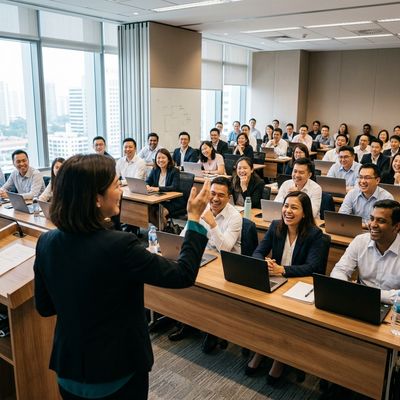
AI Quotient Training Program — five modules delivered inside live work

AI Quotient Training Program

Develop AI Talent

Work has changed permanently. Generative AI dissolved the knowledge barrier — advantage now belongs to whoever acts fastest on what AI already knows, not whoever holds the most expertise.

The multi-disciplined workforce enterprises always wanted is no longer a stretch goal. AI made it the baseline. Five modules build the quotient that gets a team there — taken whole or in part, delivered as structured workshops or by an embedded trainer inside live work.

Structure
5 modules · 14 units
Cadence
Spread across 8–12 weeks
Delivery
Structured or embedded
Scoping
Modular — take what you need

Human + AI Outperforms Either Alone

The Amplified Talent Imperative

Paired well, human and AI beat solo performance on quality, speed, and creativity. And the lift is not evenly distributed — AI raises the least experienced the most, closing the gap across a team rather than widening the lead at the top.

That makes talent, not tooling, the decisive variable. Which is what these modules train.

40% higher-quality work delivered with AI
25% faster completion, more tasks finished
+43% the biggest gains went to the lowest-scoring performers

Harvard / Wharton / BCG field experiment — consultants using GPT-4 against a control group.

What a Team Looks Like Afterwards

Outcomes

Five capabilities that accrue, each measured so a team knows where it stands and what to build next. This is a trained reflex, not a workshop memory.

Hyper-Productivity

Multiplier outcomes at accelerated pace — output scales without scaling headcount.

M-Shaped Talent

The operating environment now rewards range — the marketer who codes the attribution model, the counsel who builds the clause-extraction agent.

Elevated Cognition

Decision quality reaches a caliber neither intelligence attains alone — human judgment fused with machine-scale pattern recognition.

Agentic Automation

Automation advances beyond rule-based flows into advanced non-deterministic workflows that reason, adapt, and resolve ambiguity.

Algorithmic Competitiveness

Talent fluent enough to compete on algorithmic terms — designing, deploying, and governing the agentic systems now setting the market's pace.

The ceiling is not 20% higher. It is reset categorically.

See how the modules get there →

Five Modules, One Quotient

The Curriculum

Each module carries its own transformation, and the structure is modular — a programme runs the modules a team actually needs, in the order that suits it. Select a module to see what it covers.

What It Covers

  • Co-intelligence as a working discipline — structured collaboration patterns and sentence-level interweaving, not ad hoc prompting, for treating AI as a genuine reasoning partner.
  • Mapping the jagged frontier task by task: distinguishing domains of AI reliability from domains of confident failure, so trust is calibrated rather than assumed.
  • Metacognitive practice — auditing one's own reasoning inside the AI loop, not only the model's output, to catch where judgment quietly degrades.
  • Critical thinking translated into practice: dialectical pressure-testing that turns 70%-certainty signals into decisive, defensible calls rather than analysis paralysis.

The Transformation

Judgment compounds instead of stalling. Calibrated trust — not blind reliance or reflexive caution — determines where oversight is spent, and elevated decision quality becomes a standing capability the team owns rather than an occasional win.

What It Covers

  • Prompt engineering from first principles — why AI misses the mark, the scaffolds that fix it, and the reasoning techniques that raise output quality.
  • Context engineering: curating the entire context window rather than tuning a single message, and testing prompts as experiments rather than guesses.
  • The modes of cognitive augmentation — knowledge synthesis, structured reasoning, creative multiplication, and process augmentation across a workflow.
  • Augmented sensemaking across messy inputs: documents and unstructured data, spoken audio, images and video, and high-detail comparison work.
  • AI-augmented building — prototyping, publishing, integrating, and debugging real working tools, with the security gate that vibe-coded work usually skips.

The Transformation

Every practitioner ships something real. Synthesis-heavy work — briefs, analyses, decks, models, code — collapses against a different cycle time, and work that was queued or outsourced gets built in-team.

What It Covers

  • New learning modes: active, self-directed learning, inductive uptake, and learn-by-doing in place of reading for coverage.
  • Configuring AI as an adaptive tutor pitched to the learner's level — plus the guardrails that preserve the productive struggle learning requires.
  • Cross-domain onboarding and conceptual translation: the fastest on-ramp into an unfamiliar field, and how to test where the map is wrong.
  • Interdisciplinary transfer between domains, and calibrating scepticism where AI's most exciting analogies quietly break.
  • Expert networks, fact-grounding, and source curation as the standing check on confident error.

The Transformation

People move into adjacent domains in days rather than quarters. Multi-disciplined range — deep in more than one place — becomes the team's default profile rather than a rare hire.

What It Covers

  • Data and prompt hygiene: what never enters a prompt, how sensitive and regulated data is handled, and safe patterns for examples.
  • Secrets and IP discipline in AI-assisted work, treating AI output as untrusted until verified, and least-privilege access for AI tools and actions.
  • Bias awareness in AI-assisted decisions — mitigating skewed judgement, not only catching factual error.
  • Accountability: who signs off on AI-assisted work, on what basis, and how that decision stays documented and auditable.
  • Transparency and broader impact — appropriate disclosure of AI use and weighing downstream effects on customers, colleagues, and the public.

The Transformation

Adoption scales without the incident that stalls it. Leaders gain a defensible answer to who approved AI-assisted work and why — so speed and assurance stop trading against each other.

What It Covers

  • AI tech foundations: web automation, no-code orchestration, agent frameworks, working with unstructured data, and retrieval done properly.
  • Agentic engineering — building agents that retrieve, reason, and act, and the scaffolding that makes them reliable enough to trust.
  • Workflows that accrue: self-verifying agents, plan-first parallel execution, and reviewing the prompt rather than the output.
  • Verification and recovery engineering — catching AI failure and repairing it before it propagates across a system.
  • Organisational redesign: hybrid team synchronisation, first-principles process rebuilds, and fused AI-augmented roles.

The Transformation

Automation extends into judgement work, not just deterministic flows. Gains stop being personal and become structural: the function holds a multiple, and the team operates at the clock speed its market now runs at.

Training That Lives Inside the Work

The Delivery Model

A two-day intensive changes what a team knows. It rarely changes what a team does. Both delivery modes are therefore spread over time — progressive learning with room between sessions for the practice that turns technique into reflex.

Mode One

Structured Workshops

Classroom-style training on the modules a team selects, run across weeks rather than in a single intensive.

Each session ends with applied practice, and the next opens on what that practice surfaced.

  • Taught, structured progression — A common standard delivered to a cohort, in a defined order, with assessment against the quotient.
  • Spaced for internalisation — Gaps between sessions are deliberate — technique is used on real work before the next module lands.
  • Scales across functions — Suited to larger groups and to organisations establishing a baseline across several teams at once.

Mode Two · Highest Transformation

Embedded Training

An embedded trainer works alongside the direct team, inside its live work.

Coaching happens on the actual briefs, analyses, decks, models, and code the team already owes the business. Habits form where the work happens, which is why this mode produces the deepest change.

  • Live work as the material — No synthetic case studies — the team's own deliverables are the practice ground.
  • Team-level, not individual — The direct team trains together, so a new standard lands as shared practice, not scattered skill.
  • Measured on shipped output — Progress is read from the work produced, not from a course-completion certificate.

Entry Points and Scoping

Complementary Formats

Team Building Workshops

Compact, team-oriented sessions built around hands-on activities rather than lecture — half-day or single-day, run in small teams. Useful as an entry point before a longer engagement, a cross-function alignment moment, or a reinforcement beat between cycles.

  • Activity-led, team-versus-team formats
  • Shared vocabulary across functions in one sitting
  • Also delivered as public workshops

Modular By Design — Take What the Team Needs

There is no obligation to run all five modules. Delivery is assembled from the modules and units that match where a team stands and what it is accountable for — a single module for a focused gap, a governance-and-craft pairing for a regulated function, or the full quotient where the ambition is org-wide transformation.

  • Any subset of the 5 modules and 14 units
  • Sequenced to the team's function and starting point
  • Extendable module by module as capability builds

Bring The Modules Your Team Needs

AI Quotient Training Program

Embedded delivery, team building workshops, and public cohorts — scoped to where your team stands today. Modular by design: take the full quotient or the subset your function demands.

AI Quotient Training Program — five modules delivered inside live work