Modern data engineering stack purpose-built for AI workloads

We Engineer the Data Stack That Determines What Your AI Can Achieve

Deliver AI Use Cases

Model layers commoditise. Data layers accrue. We assess legacy data estates, design AI-native architecture, build production pipelines, and operate in regulated environments, whether cloud-native, on-premise, or air-gapped. The teams pulling ahead are the ones with embedding pipelines that produce reproducible RAG, feature stores that eliminate training-serving skew, and vector storage purpose-built for AI workloads. That infrastructure is engineered, not inherited.

We Are AI Specialists Who Understand Data

What We Do

Data engineering for AI works in both directions. We build the infrastructure AI workloads require, and we deploy AI to modernise the data engineering function itself.

Infrastructure → AI

Flawless Data for AI

The pipeline layer that makes AI reliable, reproducible, and compliant in production.

We design, build, and operate the data infrastructure AI workloads actually require - feature stores, embedding pipelines, vector stores, real-time serving, lineage, and governance. Built for the specific cadences, failure modes, and audit requirements that distinguish AI systems from analytics workloads.

AI → Infrastructure

AI-Modernised Information Delivery

The data engineering function that improves continuously rather than scaling linearly with headcount.

We deploy AI to modernise the data estate itself, translating legacy pipelines and unmaintained code, automating quality detection and root cause traversal, and instrumenting the stack with self-monitoring capabilities that were previously too expensive to operate at scale.

Three Truths That Determine Whether AI Thrives

Why Data Is the AI Advantage

Every AI team we work with reaches the same conclusion, usually after their second production deployment. The model was never the hard part. The data was. The assessment reveals the same gaps at comparable points of the journey, along with the engineering path to close them.

Models Commoditise. Data Layers Accrue.

Frontier model capabilities improve every six months as access costs fall. None of that translates to durable advantage unless the data layer captures it. We focus the engagement on the assets that endure - the proprietary embedding pipelines, curated training corpora, and entity-resolved feature stores that accrete value as the model layer commoditises. The model is rented. The data stack is owned.

AI Workloads Have a Shape

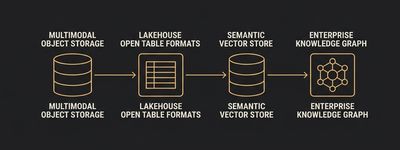
Embeddings at scale. Multimodal data in petabytes. Feature serving in single-digit milliseconds. End-to-end lineage from prediction back to source. Legacy warehouses were built for rows of transactions, not vectors of meaning. We assess the gap between the analytics warehouse in place and the AI-native storage primitives the workload needs, before the team discovers it mid-project.

Deployment Context Drives Architecture

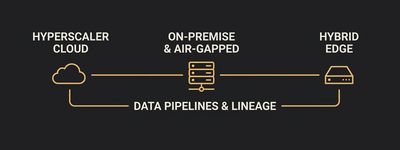
A retailer ships on hyperscaler cloud. A defence contractor ships on air-gapped infrastructure. A regulated bank ships on sovereign on-premise. A manufacturer ships at the edge. The same data lifecycle looks different in each environment. We have built in all four contexts. Architecture conversations that ignore deployment environment produce designs the business cannot ship.

How AI Requirements Impact Every Layer of the Stack

The AI Data Lifecycle

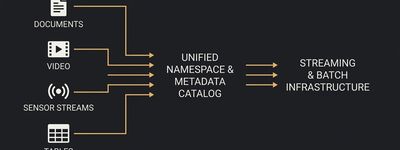
The lifecycle is the same in every engagement - ingestion, transformation, storage, features, serving, deployment. The implementation changes with the workload, the environment, and the regulatory context. We deliver across all six layers.

AI Pipelines Break Differently Than BI Pipelines

DataOps

Traditional DataOps optimises for query freshness. AI DataOps optimises for something harder: reproducible training runs, feature consistency at inference, drift detection before model degradation, and data architecture that AI agents can navigate without hallucinating structure. The discipline carries the same name, but the failure modes and the requirements are categorically different.

Orchestration for ML, LLM Fine-Tuning, and Edge

ML retraining cadences differ from LLM fine-tuning cycles. The latter requires curated instruction datasets, preference pairs, and RLHF signals with their own freshness and curation requirements. The orchestration layer handles both, and extends to edge deployment: the data decisions that determine whether on-device model inference sees the distribution it trained on are made at the pipeline layer, not at compile time.

CI/CT - Release Engineering for Living Systems

CI/CD for code is standard practice; CI/CT for models and features is where most AI initiatives break down. Automated retraining pipelines run with model regression gates, and real-time feature stores enforce that the serving environment sees the same distribution training promised.

Quality Gates That Protect Distribution Integrity

Schema validation catches obvious failures; it does not catch the quiet ones. Where the schema is intact but the distribution has shifted and the model operates outside its training envelope. Statistical distribution checks run at every pipeline stage, and drift on pipeline outputs surfaces as an operational alert before it reaches the model.

Data Architecture That AI Can Navigate

When tables are described, columns carry business context, and metrics are formally defined once, an LLM can compose queries against real enterprise data instead of hallucinating structure. The semantic layer and schema contracts built into the data architecture are what make natural-language access to enterprise data reliable rather than aspirational.

Using AI To Elevate Information Delivery

Frontier DataOps

Autonomous operations, data monetisation, zero information friction: the new data capabilities within reach of modern data teams who wield AI.

Self-Monitoring Pipelines

ML anomaly detectors learn the expected distribution of each feature and flag deviations that no static threshold catches. Known failure classes execute standard remediations automatically. The pipeline surfaces and begins resolving its own degradation before downstream systems confirm it.

LLM-Driven Root Cause Traversal

When a model degrades, an LLM agent traverses the lineage graph upstream from the failure, correlates the timing of changes with the point of degradation, and surfaces the most probable cause. Investigation that took hours runs in minutes; the on-call sees a diagnosis in the incident channel, not an alert to start from scratch.

Learning-Based Orchestration

Airflow, Dagster, and Prefect emit enough execution history to learn from — scheduling retries when transient failures are likely to clear, allocating resources in proportion to predicted runtime, batching jobs when cluster contention is low. The orchestrator becomes a planner rather than a timer.

Semantic Entity Resolution

Embeddings over names, addresses, descriptions, and transaction patterns find matches that deterministic rules miss — the transliterations, abbreviations, and real-world variations that fuzzy-match logic cannot reach. Customer-360, supplier-360, and product-360 efforts that stalled on matching logic ship on data quality instead.

Unstructured Data Extraction and NL Access

Foundation models with structured-output APIs turn text in contracts, claims, recordings, and inspection photos into queryable rows in the warehouse. Every renewal date, penalty clause, and churn signal that never reached the CRM becomes accessible. The conversational interface over the semantic layer makes this data available to business users and AI agents through natural language.

Legacy Pipeline Modernisation

AI reads, documents, and translates stored procedures, COBOL, SAS, and Informatica jobs at a cost that collapses the business case for modernisation from a multi-year programme to a quarterly initiative. The parity harness that proves the rewrite produces the same numbers on the same inputs is what makes the migration defensible to the business owners who depend on those numbers.

Three Foundations That Accelerate Every AI Use Case That Follows

Where to Start

The organisations that pull ahead in AI do not start with the most ambitious use case. They build three foundational capabilities that make every use case faster, cheaper, and more defensible, and then the portfolio accelerates because each new model inherits the infrastructure the previous ones built.

Feature Store with Online Serving

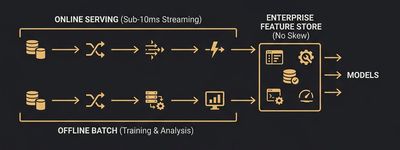
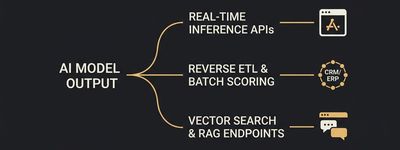
Eliminating training-serving skew is the single highest-leverage investment in a production ML programme. Features computed once — entity-resolved, versioned, tested — are available to every model that follows. Sub-10ms feature serving is the infrastructure that makes real-time inference viable: fraud detection, dynamic pricing, personalisation, and recommendation all depend on it.

Embedding Pipeline & Vector Store

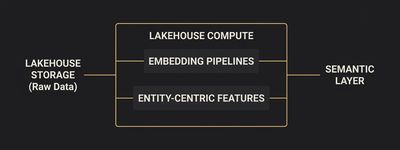
Chunking, vectorising, and indexing the highest-value document corpus unlocks RAG, semantic search, and LLM-grounded reasoning across the enterprise in weeks. Treating the embedding pipeline with the same engineering discipline as any other data pipeline (tested, versioned, lineage-traced) separates AI products that hold up in production from ones that degrade silently.

Semantic Layer

Define every business metric once in the semantic layer and make it the mandatory interface for every BI tool, LLM agent, and downstream model. When an LLM composes queries against formally-defined metrics instead of raw tables, natural-language data access becomes reliable rather than aspirational. The foundational layer for conversational analytics and agentic data workflows.

Begin the Next Chapter of Your Data Journey

Next Step

An AI delivery company that understands data. We know what AI needs from data, and we bring AI itself to modernise the data stack: self-monitoring pipelines, semantic resolution, unstructured extraction, legacy modernisation. The conversation starts from the binding constraint in your data architecture, not a generic maturity exercise.

Data architecture assessment across cloud, on-premise, and air-gapped environments