“What did we promise this account, and what has changed since?”
The Model Is Not the Bottleneck. Memory Is.
AI Product - Tellipath
AI Agents rarely fail at reasoning. They fail at what they can find outside their limited memory. Tellipath is a memory engine for systems that must answer from long episodic history, not just the last ten messages.
one memory layer, many signals
Search Is Not Memory
01 — The Failure Mode
The industry solution has been Retrieval Augmented Generation (RAG) with vector search. Vector search returns text that resembles the question. Memory returns what is true now, who said it, and what changed since. Most enterprise assistants ship the first and are sold as the second.
The gap surfaces fastest in support. Miss the prior escalation, the promise already made, or the customer's stated channel, and the interaction resets to zero — regardless of how capable the model is.
Superseded notes. Matching words. None of the latest truth.
Confident tone. Incomplete context. No way to tell which.
The Use Cases Worth Building All Depend on One Thing
02 — Where It Pays Off
Support that opens with perfect memory of the customer
Every conversation starts where the last one ended. Resolution time falls because nobody — agent or customer — spends the first five minutes rebuilding the history.
Renewals that carry the entire relationship history
Stated goals, live objections and every commitment made survive the rep who made them, instead of dying in a CRM note.
Advice shaped by every preference the client has voiced
Recommendations built on years of expressed preference — and on what the client already declined — not the segment a profile assigned them.
These are not three problems. They are one retrieval problem wearing three business labels — which is why repairing the memory layer once unlocks all three, and why another round of prompt engineering unlocks none of them.
Five Problems Vector Search Does Not Solve
03 — Core Challenges
What changed
Old facts and new facts both exist in the corpus. Only one of them is true today.
Who is who
One person, team or incident appears under many names across many systems.
What they meant
The same instruction arrives in wording that shares no vocabulary at all.
When not to answer
A system that cannot abstain will invent. Abstention is a feature, not a gap.
What they prefer
Preferences shape the correct answer, and they drift long before anyone restates them.
Finding one answer can mean remembering months of history
04 — The Hard Part
The useful facts may be scattered across many conversations — surrounded by information that has nothing to do with the question.
01
Connect the right conversations
Months of history
Jan 09
Jan 27
Feb 11
Feb 23
Mar 05
Mar 30
Apr 14
May 02
May 21
Only a few matter
“I'm looking for someone to service my Korg B1 piano.”
Relevant“Planning the family holiday for July.”
“I've been playing my Fender Stratocaster.”
Relevant“Which lens should I get for the camera?”
“That restaurant on the corner was excellent.”
“I've had my Yamaha FG800 acoustic guitar for about 8 years.”
Relevant“The aquarium needs a new filter.”
“I'm thinking of selling my Pearl Export drum set.”
Relevant“Booking the car in for a service.”
The question
How many musical instruments do I currently own?
Piano
Electric guitar
Acoustic guitar
Drum set
4
instruments
The answer was never in one conversation.
02
Time changes the answer
The question
How many months have passed since my last museum visit with a friend?
“I visited the Science Museum with a friend.”
friend ✓“I visited the Natural History Museum with my dad.”
dad ≠ friend“I attended a History Museum lecture.”
lecture ≠ visit with friendThe question is asked.
5 months
Most recent is not always most relevant.
Example adapted from the LongMemEval long-term memory benchmark.
Tellipath turns conversation history into usable memory.
Tellipath — A Memory Layer, Not a Search Index
05 — The Product
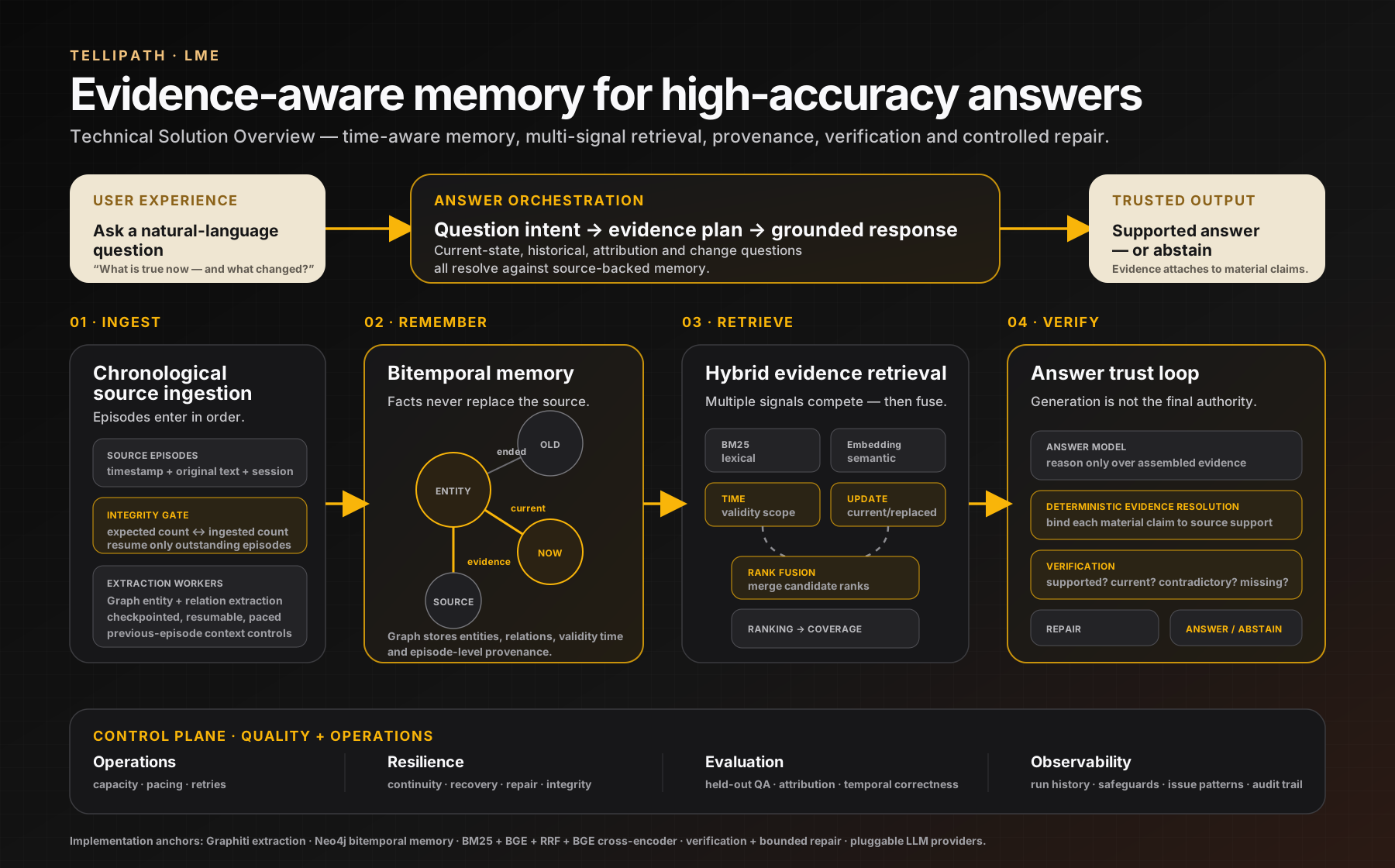
Episodes enter in chronological order and are never overwritten. Extraction builds entities and relations with validity time attached, so the graph can answer what is true now and what was true then. Retrieval combines the graph with hybrid search, and every material claim carries the source it came from — or the answer abstains.
Hybrid retrieval
Finds the right context, not the nearest wording.
Temporal graph
Entities, relations and validity time in one store.
Evidence binding
Material claims carry the source episode that supports them.
Verify or abstain
Bounded repair when facts and meaning disagree. Silence when they cannot be reconciled.
More complete context. Fewer wrong answers.
06 — Performance
Tellipath finds the complete information needed 96.6% of the time, compared with 80.4% for Mem0, a leading AI memory platform.
So your AI works with the full picture — not fragments of it — for more reliable answers, automation, and decisions.
96.6%
Tellipath
80.4%
Mem0
Based on LongMemEval complete-evidence recall at Top 10.
Every One Started as a Client Constraint
07 — AI Products
Nothing here began as a product idea. Each one is a problem that kept surfacing across engagements, built for a client first and shipped only once it held up in production. Tellipath is the first. It runs on your own infrastructure, against your own history.
enquiry@commune-ai.net