DIAGNOSE Framework

Delivery Approach

Most AI initiatives fail from misaligned focus, not technical shortcomings. DIAGNOSE is our systematic approach to finding WHERE AI creates transformative value—starting with business process reality, not technology capabilities.

Eight Steps to Opportunity Clarity

Systematic Approach

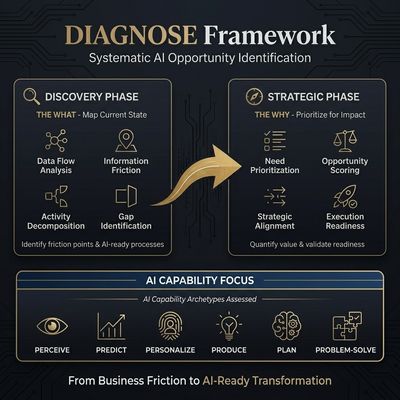
DIAGNOSE guides assessment through eight sequential steps that yield a prioritized opportunity portfolio:

Data Flow Analysis → Information Friction Mapping → Activity Decomposition → Gap Identification → Need Prioritization → Opportunity Scoring → Strategic Alignment → Execution Readiness

We start by mapping how information flows through your organization and identifying friction points—the synthesis burdens, signal overwhelm, and knowledge fragmentation that slow decisions and degrade quality. We then decompose activities to determine what should remain human-led versus AI-augmented, and prioritize opportunities by value and feasibility.

DIAGNOSE - 8 Steps to AI Opportunity

The Framework

Each step builds on the previous, creating a complete picture of where AI can create genuine value in your operations.

D - Data Flow Analysis

Map how information moves through the organization. Identify data assets, integration points, and latent intelligence using the STREAM protocol (Sources, Transformations, Repositories, Exchanges, Access, Monitoring).

I - Information Friction

Identify where information flow creates operational drag—delays, errors, rework, and cognitive burden that slow decisions. This is where AI creates the most value.

A - Activity Decomposition

Break processes into atomic activities for AI assessment. Classify by cognitive complexity and volume to determine what should be automated, augmented, or remain human-led.

G - Gap Identification

Find the delta between current capabilities and optimal operation. Four gap types: Capacity (volume overwhelm), Capability (skill shortage), Consistency (variance), and Velocity (speed insufficiency).

N - Need Prioritization

Rank gaps by business impact using the VALUE framework: Volume affected, Acumen consumed, Latency caused, Uniformity variance, and Exposure risk created.

O - Opportunity Scoring

Quantify value using the PRIZE model (Productivity, Revenue, Intelligence, Zero-defect, Experience) and assess feasibility across data readiness, technical fit, and organizational capacity.

S - Strategic Alignment

Verify connection to organizational strategy. Does this support top objectives? Does it build desired capabilities? Does it advance competitive positioning?

E - Execution Readiness

Assess organizational capacity using the LAUNCH model: Leadership sponsorship, Adaptability, Understanding, Nurturing talent, Culture, and transformation History.

The Six Universal Information Frictions

Where Value Lives

Information friction is where AI creates the most value. We see these patterns in every organization—they're universal constraints that AI is uniquely positioned to address.

Synthesis Burden

Experts spend 60-70% of time gathering information versus 30-40% analyzing. Demand planners synthesizing 3 systems for 90 minutes daily. Underwriters assembling context for 25 minutes per case.

Signal-to-Noise Overwhelm

Alert systems designed to catch everything catch too much. 47 daily variance alerts with only 10 meaningful. 95% false positive rates on AML alerts. 120-page PDFs with 10% requiring review.

Knowledge Fragmentation

Critical expertise trapped in individuals, not systems. Site selection expertise concentrated in one 12-year veteran. 23% disruption increase when key planner is absent. 20 years experience lost with single retirement.

Cross-Boundary Blindness

Decisions made without visibility into upstream or downstream impacts. Inventory allocation without marketing calendar visibility. Operations unaware of customer impact. Claims decisions without liability documentation.

Velocity Mismatch

Decision cycles lag behind event cycles. 48-72 hour lag in campaign performance data. Quarterly model validation despite monthly drift. Weekly credit committee despite daily market changes.

Context Deprivation

Frontline workers lack information to resolve issues. Service agents can't see loyalty status or campaign history. Customer agents navigate 3-5 systems per inquiry. Escalations due to missing context, not skill gaps.

How We Apply DIAGNOSE

Engagement Options

Rapid Diagnostic (2-3 days): Stakeholder interviews with 10-15 key roles, process observation, friction scoring, and initial opportunity long-list.

Comprehensive Diagnostic (4-6 weeks): Full DIAGNOSE framework application with quantified friction and gap analysis, detailed opportunity scoring, and prioritized roadmap with business cases.

Continuous Diagnostic: Quarterly refresh of opportunity portfolio, monitoring of friction indicators, and pipeline management for transformation initiatives.

The output is always a prioritized portfolio of AI opportunities with quantified business cases, ranked by value, feasibility, and strategic fit.
AI diagnostic assessment and opportunity identification

Ready to Identify Your AI Opportunities?

Next Steps

DIAGNOSE tells you where to focus. TRANSFORM shows you how to capture that value through process redesign. Together, they form a complete methodology for enterprise AI transformation.

AI diagnostic consultation and assessment planning